Voyager at 40
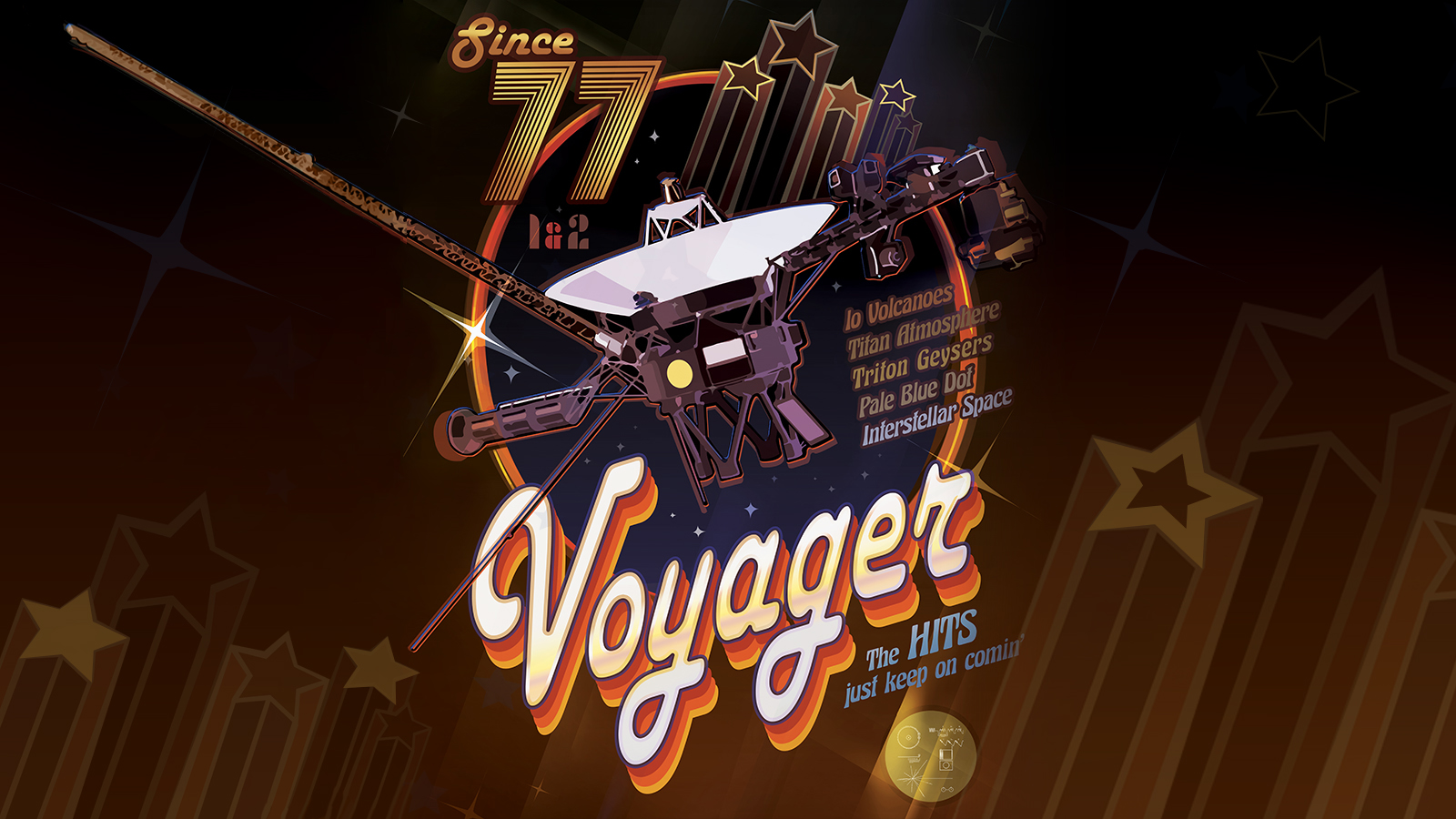
I recently had the incredible opportunity to attend an event held by the Royal Astronomical Society of Canada (RASC) which featured a talk by Director Randy Attwood commemorating the journey of the two Voyager probes on their 40th anniversary. Launched in 1977, their mission over a period of 12 years was to explore four outer planets – Jupiter, Saturn, Uranus and Neptune – leading to discoveries that would forever change our understanding of the solar system.
There were a few interesting facts I learned about the Voyager mission:
1) The mission of the Grand Tour was to fly by all four Jovian planets, but only received government funding to explore Jupiter and Saturn. However, NASA decided to stick with the original mission and take advantage of a rare planetary alignment that occurs once every 175 years. This particular alignment enabled a single probe to visit all of the outer planets (with the exception of Pluto) by using the orbital energy and gravitational force of each, to propel itself towards the next one.
2) Voyager 2 was launched sixteen days before Voyager 1. The plan was to have Voyager 2 travel on a “slow trajectory” which would potentially allow it to fly by all four planets. Whereas Voyager 1 was scheduled to visit Jupiter and Saturn on a “fast trajectory” before heading off into deep space.

3) The Golden Record aboard the probes are more sophisticated than those on the Pioneer spacecrafts and consists of an eclectic mix of natural sounds, music, greetings from 55 different languages and a total of 115 images – including one of our very own Pearson International Airport! If aliens were to intercept either probe some day, they would first need to figure out how to use the record player.
4) NASA still continues to hire employees fluent in FORTRAN and assembly language for creating solutions to monitor and conserve energy levels of the probes. They currently have enough power to run for at least another decade.
5) The probes are floating among the stars billions of miles away and are only able to communicate with Deep Space Station 43 (DSS-43) antenna which is located close to Canberra, Australia.
The one thing that left me curious was the amount of time it takes to communicate with the probes. Let’s do the math, shall we?
Since radio waves are a type of electromagnetic radiation, they travel at the speed of light which is 299,792,458m/s or 1,079,252,848.8 km/hr.
As of November 4, 2017:
Voyager 1:
*Distance from Earth = 21,080,467,140 km

Time taken to transmit/receive signals (one-way) = Around 19 hours and 30 minutes
Voyager 2:
*Distance from Earth = 17,375,185,936 km

Time taken to transmit/receive signals (one-way) = Around 16 hours
* Distance travelled can be found on NASA’s Voyager Mission Status page. These numbers continue to increment every second and consequently, communication time also increases.