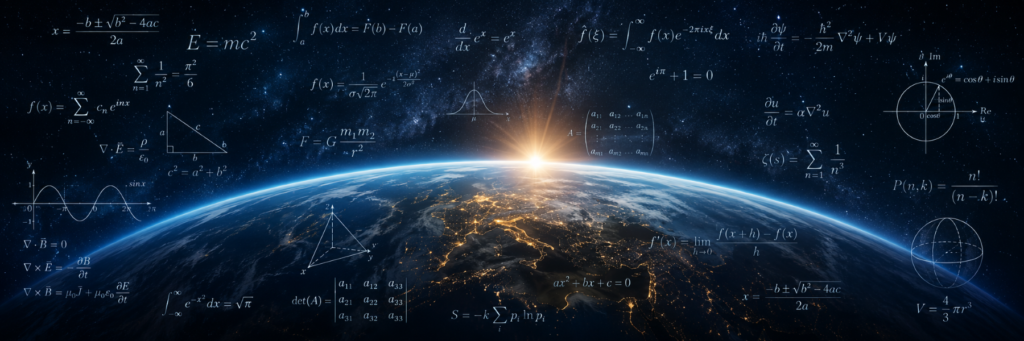
You have arranged all things by measure and number and weight.
Wisdom 11:20
Every day we use mathematics without giving it much thought. Engineers use it to build bridges. Doctors use it to understand physiology. Astronomers use it to track planets. Physicists use it to describe everything from atoms to galaxies. And we all use it every pay day to balance household budgets. Mathematics is used to calculate and create projections for the most profound to the most mundane.
Yet there is something interesting hiding beneath this familiarity.
Why should mathematics work at all?
Mathematics itself is not made of atoms or energy. Nor is it an experimental science.
Nobody has ever discovered the number π (pi) under a microscope or found the Pythagorean theorem in a laboratory.
Mathematical truths seem to exist in its own realm of abstract reality, yet they somehow describe the physical world with uncanny accuracy.
Mathematics Predicts Reality Before We See It
One of the most remarkable aspects of science is that researchers do not always begin by observing a phenomenon and then building a theory around it.
Sometimes the mathematics comes first.
Long before a discovery is made in a laboratory or observed through a telescope, an equation quietly points toward something that has never been seen.
A famous modern example is the Higgs Boson.
In 1964, Nobel Prize-winning theoretical physicist Peter Higgs proposed the existence of an invisible field that permeates the universe. According to his calculations, certain fundamental atomic particles acquire mass through their interaction with this field. His theory implied the existence of a previously unknown particle – the Higgs Boson.
For nearly fifty years, this particle remained purely theoretical. Then, in 2012, scientists working at CERN with the Large Hadron Collider announced its discovery, confirming a prediction that had existed on paper for almost half a century.
The story of Neptune is equally fascinating.
After the discovery of Uranus in 1781, astronomers noticed subtle irregularities in its orbit. According to Newton’s laws of gravity, Uranus should have followed a slightly different path. Rather than abandoning the mathematics, scientists proposed another explanation: perhaps an unseen planet was exerting its own gravitational influence.
Working independently, mathematicians Urbain Le Verrier and John Couch Adams calculated the position of this unknown world. In September 1846, astronomers pointed their telescopes toward the predicted location and found Neptune almost exactly where the mathematics said it would be.
History is filled with similar examples.
James Clerk Maxwell’s equations predicted radio waves before anyone had detected them. Albert Einstein’s theory of General Relativity predicted gravitational waves more than a century before they were finally observed.
Again and again, mathematics seems to reveal aspects of reality before reality reveals them to us.
The Mystery Scientists Have Noticed
This strange relationship between mathematics and the physical world captivated Nobel Prize-winning physicist Eugene Wigner, who explored it in his famous 1960 essay, The Unreasonable Effectiveness of Mathematics in the Natural Sciences.
The mystery is not merely that mathematics is useful.
The mystery is that it is extraordinarily useful.
Why should symbols written on paper correspond so precisely to stars, atoms, gravity, light, and space-time?
Why should abstract concepts developed in the human mind map so faithfully onto the structure of the universe?
One possible answer is that human beings evolved to recognize patterns. Our ancestors survived by detecting order in the world around them, and our mathematical abilities may simply be a sophisticated extension of that instinct.
Yet this explanation seems incomplete.
Pattern recognition may help explain why we can discover mathematical laws, but it does not explain why those laws exist in the first place.
Why does a universe composed of matter and energy obey elegant mathematical relationships?
Why were these relationships present billions of years before human beings appeared to discover them?
And how is it that mortal minds shaped by the demands of survival can uncover truths about black holes, quantum particles, distant galaxies, and the origins of the cosmos?
Wigner himself expressed the mystery with characteristic humility:
The miracle of the appropriateness of the language of mathematics for the formulation of the laws of physics is a wonderful gift which we neither understand nor deserve.
The Deeper Question
Science excels at describing the patterns of nature. It tells us which equations work, how accurately they predict reality, and how those discoveries can be applied in practical ways.
Yet behind every scientific explanation lies a deeper assumption: that nature possesses patterns that can be understood.
The existence of those patterns is itself a mystery worthy of reflection.
Science can explain how mathematical laws operate, but it cannot tell us why the universe is mathematically intelligible in the first place.
For many people of faith, this intelligibility is not an accident.
If reality ultimately comes from a rational Creator, then perhaps it is not surprising that creation bears the marks of order, structure, and reason. Nor is it surprising that minds capable of rational thought can discover and understand those patterns.
This perspective does not compete with science. Rather, it addresses a different question altogether. Science asks how the universe works. Faith wonders why a universe exists that can be understood at all.
We often look for signs of the sacred in dramatic experiences – in miracles, visions, or extraordinary events.
Yet one of the most beautiful mysteries surrounds us every day: A universe governed by elegant mathematical laws.
Equations conceived within the human mind somehow describe stars billions of light-years away, particles too small to see, and invisible forces that shape the cosmos itself. Whether one sees this as a coincidence, a brute fact of survival, or the whisper of a Creator, it remains a mystery.
As I reflect on it, I cannot help but wonder if the remarkable intelligibility of the universe points beyond itself – not as proof of God, but as an invitation to contemplate Him.
Perhaps God is not only found in the extraordinary.
Perhaps He is also hidden in plain sight.
† Glória Patri, et Fílio, et Spirítui Sancto. Sicut erat in princípio, et nunc, et semper, et in saécula saeculórum. Amen. †