There are moments when science doesn’t give me an answer.
But it always gives me a reason to wonder.
Recently, I stumbled across something I had somehow never encountered before: a tiny protein called laminin.
It is one of those discoveries that made me pause – not because it proves anything about God, but because the deeper I look into biology, the harder it becomes for me to see life as ordinary.
So, what exactly is a laminin?
A Tiny Piece of the Architecture of Life
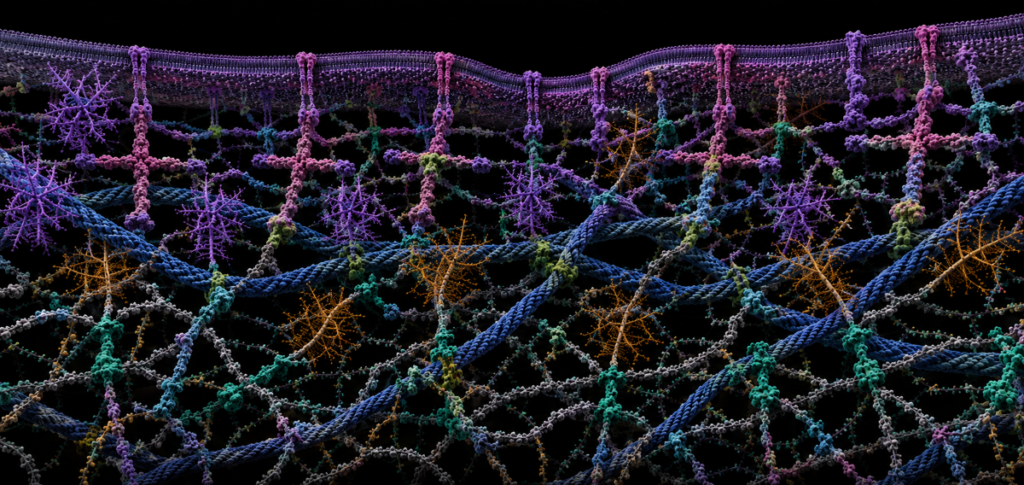
Laminins are a family of glycoproteins – proteins with attached carbohydrate chains – that are major components of the extracellular matrix, the intricate network of molecules surrounding our cells.
Many laminins are found in structures called basement membranes.
Think of a basement membrane as a microscopic layer of biological scaffolding. It helps separate and support tissues while providing cells with a surface to attach to and interact with.
And laminins are an important part of that scaffolding.
But “scaffolding” is only part of the story.
Laminins don’t simply provide physical support. They also interact with receptors on the surfaces of cells and help transmit signals that influence how cells grow, move, differentiate and respond to their surroundings.
In other words, they are not passive glue.
They are part of a remarkably sophisticated communication and support system operating at a microscopic scale.
And this is happening inside us right now.
Helping the Body Repair Itself
One of the things I find particularly fascinating is laminin’s involvement in tissue development and repair.
Consider the peripheral nervous system.
After certain peripheral nerve injuries, Schwann cells – specialized support cells of the nervous system – help create an environment in which damaged nerve fibers can regenerate.
Laminins are part of that environment.
They provide important signals and structural support that help Schwann cells function and help regenerating axons grow in the appropriate direction.
So when we think about healing, it isn’t simply a matter of damaged tissue “growing back”.
There is an extraordinarily complex molecular environment involved – cells communicating with one another, extracellular molecules providing structural support, growth factors sending signals, and specialized cells coordinating the process.
Laminins are one small (but important) piece of that larger puzzle.
They are also involved in the formation and maintenance of blood vessels and in processes associated with tissue repair. Research has even investigated changes in laminin expression during recovery after stroke, including its relationship with angiogenesis – the formation of new blood vessels.
The more I learn about biology, the more the word complexity begins to feel inadequate.
When Something So Small Goes Wrong
Perhaps one of the clearest ways to appreciate the importance of something is to see what happens when it doesn’t work properly.
Mutations affecting laminin-related genes can cause serious diseases.
For example, changes in LAMA2, the gene encoding the laminin alpha-2 chain, can cause a spectrum of muscular dystrophies. Severe forms can involve profound muscle weakness, difficulties with movement and feeding, respiratory problems and delayed motor development.
That doesn’t mean laminin is some magical “master protein”.
It isn’t.
There are many different laminins, many other extracellular – matrix proteins, and countless molecular interactions involved in maintaining our tissues.
But it does illustrate something remarkable:
A molecule far too small for us to see with our eyes can have consequences that reach all the way to our ability to move, breathe and live.
And Then There Is the Cross
This is where things get interesting.
If you’ve spent any time around Christian social media, you’ve probably seen images of laminin accompanied by the following Bible verse:
He is before all things, and in Him all things hold together.
Colossians 1:17
And yes – some laminin molecules really do bear a striking resemblance to *THE* Cross.
But I want to be careful here.
I don’t think that the cruciform shape of a subset of laminin molecules constitutes as definitive scientific proof of Christianity.
A cross-shaped molecular structure cannot be used to establish that the Bible is true, and I don’t think its necessary to make that claim.
Doing so risks turning something genuinely fascinating into a kind of biological “gotcha.”
For me, there is a much deeper way to look at it.
Science Tells Me What. Faith Invites Me to Wonder.
Science can investigate laminins. It can describe their molecular structures, identify the genes that encode their different chains, and study how they interact with cells, tissues, and other components of the extracellular matrix. It can also investigate what happens when these systems malfunction.
And I am grateful for this knowledge.
But science and faith don’t necessarily have to compete over the same question.
Science can help me understand what a laminin is and what a laminin does.
Faith allows me to step back and ask a different kind of question:
Why does reality contain this extraordinary order and intelligibility in the first place?
As a Catholic and a lifelong student of science, I don’t look at a picture of the laminin structure and think,
“Voilà! Scientific proof. God exists. Case closed.”
That would be to claim a certainty I simply do not possess.
I cannot presume to know the mind or intentions of God. I don’t know whether He intended the structure of this particular protein to resemble the Cross, whether it carries some deeper significance, or whether the resemblance is simply one of the many remarkable patterns found throughout creation.
And perhaps that’s okay.
I don’t need to turn every beautiful scientific discovery into a proof.
I can simply allow it to awaken wonder.
How beautiful.
How intricate.
How much is happening inside me that I never knew or noticed.
Every heartbeat, every breath, every movement, every moment of healing involves layers upon layers of biological processes that I don’t consciously control.
And somehow, my life – and even my consciousness of it – is taking place within this extraordinary microscopic world every second of every day.
Perhaps that is why Colossians 1:17 resonates with me. Laminins don’t scientifically prove the verse. But the verse equips me with the language to describe the awe I already feel when I encounter the incredible order and complexity of creation.
“He is before all things, and in Him all things hold together.”
I don’t need laminins to prove my faith.
I can simply let them deepen my wonder – and be grateful that such an intricate, ordered world exists… one that allows me to live, to think, to love, and to experience the gift of being human.
And maybe that is one of the beautiful places where faith and science meet:
Science helps us see more clearly.
Faith helps us see more deeply.
God doesn’t have to shout.
We simply have to look closely.
† Glória Patri, et Fílio, et Spirítui Sancto. Sicut erat in princípio, et nunc, et semper, et in saécula saeculórum. Amen. †
Want to look closer?
If you’d like to explore the science behind laminins, here are a few excellent places to start:
- NCBI Bookshelf – Molecular Biology of the Cell: A reader – friendly introduction to laminin structure and its role in basement membranes. [NCBI Bookshelf: The Extracellular Matrix of Animals]
- The Laminin Family – PMC: A detailed scientific review covering laminin structure, diversity and biological functions. [The Laminin Family – PMC]
- NCBI GeneReviews – LAMA2 Muscular Dystrophy: An in – depth clinical resource explaining what happens when the laminin alpha – 2 system is disrupted. [LAMA2 Muscular Dystrophy – GeneReviews]
- Peripheral nerve regeneration: A scientific review discussing laminin’s role in Schwann cells and peripheral nerve regeneration. [Role of Glial Cells in Axonal Regeneration – PMC]
- Stroke recovery and angiogenesis: The study that prompted my interest in laminin’s relationship with post – stroke vascular changes. [Early Rehabilitation Exercise after Stroke – PMC]