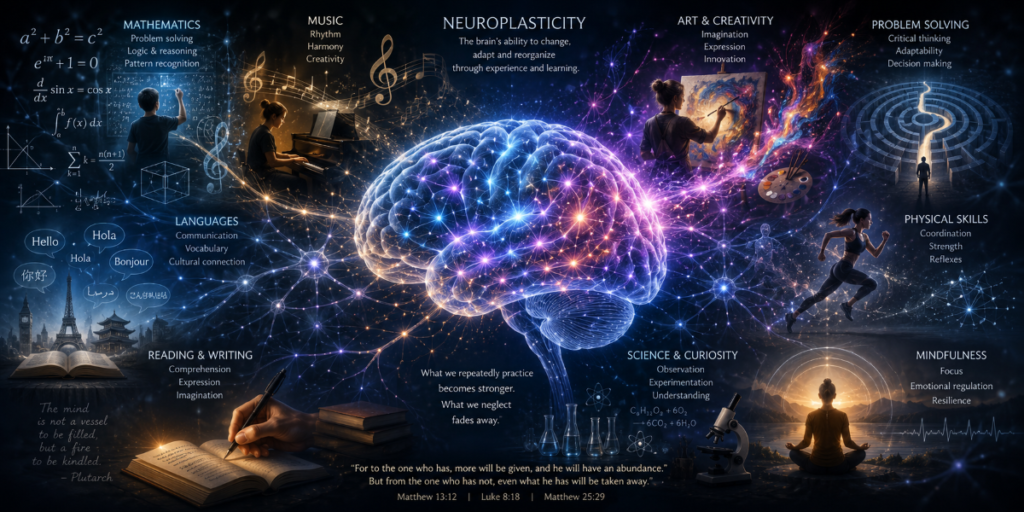
For to the one who has, more will be given, and he will have an abundance. But from the one who has not, even what he has will be taken away.
Matthew 13:12, 25:29; Luke 8:18
At first glance, this is one of Jesus’ more puzzling sayings.
I’ve heard it applied in many different ways over the years.
- The harder you work, the more successful you become.
- The more money you invest, the more wealth you accumulate.
- Even political debates about capitalism versus communism have borrowed this verse.
But taken on its own, it almost sounds unfair.
If Jesus consistently showed compassion toward the poor, why would He say that those who have little will lose even that?
Surely that can’t be what He meant.
Recently, during Mass, the priest offered a perspective that made this passage come alive for me.
He explained that Jesus wasn’t talking primarily about money.
He was talking about our hearts.
The more we seek God with open eyes, open ears, and an open heart, the more clearly we begin to recognize His presence. The more attentive we become to His work, the easier it is to see Him everywhere.
But if we continually ignore Him – if we close our ears, harden our hearts, and dismiss every opportunity to seek Him – our ability to recognize Him slowly fades.
It reminded me that this isn’t only true spiritually.
It’s also remarkably similar to the way our brains were designed to work.
The Brain was Designed to Grow
One of the most fascinating discoveries in neuroscience is something called neuroplasticity.
Simply put, neuroplasticity is the brain’s remarkable ability to change itself.
Every time we learn something new, practice a skill, or repeatedly think in a particular way, neurons communicate with one another. With repetition, those pathways become stronger and more efficient.
The opposite is also true.
Connections that are rarely used gradually weaken. Over time, the brain “prunes” those pathways, making room for the ones we rely on most.
In other words:
What is exercised grows.
What is neglected fades.
Consider mathematics.
Nearly everyone learns addition, subtraction, multiplication, and division as children. Because we continue using those skills throughout life, those neural pathways remain strong.
But how many of us still remember multivariable calculus?
Many of us once spent months solving complex equations in school. Yet years later, without regular practice, much of that knowledge has disappeared – not because our brains failed us, but because they were designed to strengthen what is repeatedly used and gradually discard what isn’t.
Our brains continually reinforce what we value enough to practice.
A Spiritual Parallel
I don’t think Jesus was giving a lesson in neuroscience. Yet I find it fascinating that the principle He taught is reflected in the way God designed the human brain.
- The more we pursue wisdom, the more capable we become of recognizing truth.
- The more we study, the more easily new knowledge connects with what we already know.
- The more we pray, the more naturally our minds return to God throughout the day.
Likewise, neglect has consequences.
- Unused knowledge fades.
- Forgotten skills become difficult to recover.
- A neglected prayer life often makes God’s presence seem distant – not because He has moved away, but because our attention has.
Whether we’re learning mathematics, music, languages, or growing in faith, the pattern seems remarkably consistent.
Growth feeds on faithful repetition.
Practice – Then vs Now
As a child, I spent countless hours buried beneath ginormous stacks of homework…
Math worksheets, practice exams, word problems, formula after formula.
Homework from school. Homework from tutors.
It often felt endless.
Whether that amount of homework was actually beneficial is probably open for debate.
But one lesson has stayed with me. Every teacher and tutor repeated the same phrase like a mantra:
Practice makes perfect.
Today, I’d phrase it a little differently.
Practice shapes us.
Every repetition strengthens something.
Every habit builds a new pathway.
Every choice teaches our minds what matters.
Perhaps this is one small glimpse of the harmony between faith and science.
Jesus wasn’t explaining the biology of the brain. He was revealing a timeless truth about spiritual growth.
Centuries later, neuroscience has shown that our minds flourish according to a remarkably similar principle: what is repeatedly exercised becomes stronger, while what is consistently neglected gradually weakens.
Maybe that’s not a coincidence.
Maybe the One who spoke those words beside the Sea of Galilee is the same One who designed the neurons inside our heads.
If so, then every act of prayer, every moment spent seeking truth, every small step toward God is doing more than changing our habits.
It is slowly transforming us – from the inside out.
Every day, our brains are strengthening something. The only question is:
What are we choosing to grow?
† Glória Patri, et Fílio, et Spirítui Sancto. Sicut erat in princípio, et nunc, et semper, et in saécula saeculórum. Amen. †